
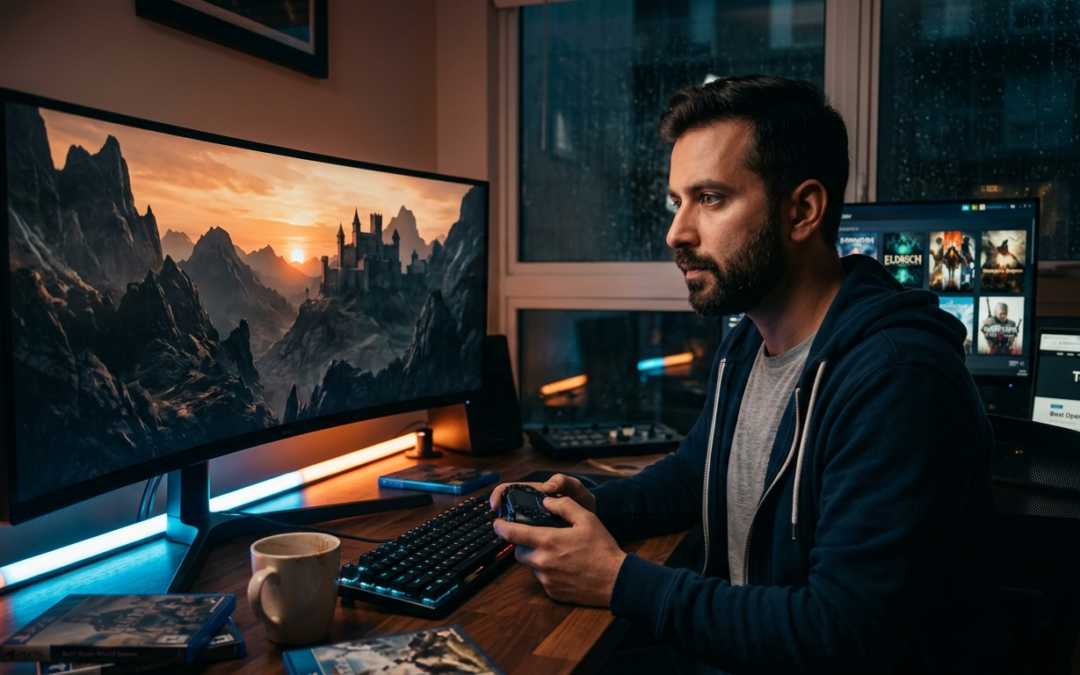
The Night I Realized My Crosshair Was Everywhere But the Head
Picture this: It is a Sunday night, the clock is ticking past 1 AM, and I am staring at a greyed-out spectator screen. My teammates are screaming in my ears because I just whiffed an entire thirty-round AK-47 spray into the empty air behind a stationary enemy.
After twelve years of running TechDhami.com and playing shooters since the early days of 1.6, you would think I would have this figured out. Instead, I was dragging my team down, feeling like my hands were made of lead.
If you are a casual gamer, a busy parent squeezing in one match a night, or a complete beginner getting absolutely bullied in Premier mode, I feel your pain. The transition to the sub-tick system and different smoke physics in this game made a lot of us feel like we forgot how to play overnight.
That frustrating night sent me down a rabbit hole. I spent the last fourteen days treating my routine like a science experiment, stripping away the useless advice, and building a daily 20-minute routine that actually works.
If you want to know how to improve aim without quitting your day job or turning into a robotic teenager who practises gridshot for eight hours a day, this guide is for you. We are going to fix your mechanics in under two weeks flat.
Why Your Current Practice Is Sabotaging You
Most casual players log into the game, jump straight into a competitive match, miss their shots during the pistol round, and spend the rest of the game tilted. Or worse, they spend an hour flying around community deathmatch maps without any actual intention, reinforcing bad habits.
The biggest lie in first-person shooters is that you just need to play more to get better. If you are practising the wrong movements, you are simply training your muscle memory to fail more efficiently.
To see real changes in your precision by next week, we have to isolate your mechanical issues. Aiming isn’t a single action; it is a combination of your physical setup, your crosshair placement, your movement mechanics, and your raw mouse control.
Setting Up Your Desk for Actual Success
Before we even talk about clicking heads, we need to address the physical reality on your desk. I see so many beginners using a tiny office mousepad and a mouse sensitivity so high that a slight breeze would make their character spin a full 360 degrees.
+-------------------------------------------------------------+
|               RECOMMENDED CS2 MOUSE SETTINGS                |
+-------------------+--------------------+--------------------+
| DPI Setting       | In-Game Sensitivity| Total eDPI Range   |
+-------------------+--------------------+--------------------+
| 400 DPI           | 1.5 - 2.5          | 600 - 1000 eDPI    |
| 800 DPI           | 0.75 - 1.25        | 600 - 1000 eDPI    |
| 1600 DPI          | 0.375 - 0.625      | 600 - 1000 eDPI    |
+-------------------+--------------------+--------------------+
If your total eDPI (which is just your mouse DPI multiplied by your in-game sensitivity) is over 1200, you are playing on hard mode. Lowering my sensitivity felt incredibly sluggish for the first two days, but it instantly smoothed out those tiny, shaky micro-adjustments that cause you to miss long-range duels down the long A ramp on Dust II.
Get yourself a massive cloth mousepad that covers half your desk. You need space to swing your arm for large turns, leaving your wrist completely free to handle the precise micro-corrections required for headshots.
Master This Secret to Learn How to Improve Aim Faster
If your crosshair is constantly pointing at the floor while you walk around corners, you are forcing your brain to do twice as much work. You have to react to the enemy, drag your mouse up to their head, and then click.
BAD PLACEMENT (Floor Hugging):
[Enemy Head]  <-- Big distance to travel
      ^
      |
[Crosshair] -> (Aiming at ground/legs)

GOOD PLACEMENT (Head Level):
[Enemy Head] <-> [Crosshair] (Instant micro-adjustment)
Good crosshair placement means your crosshair is already resting exactly where the enemy’s head will appear before they even walk around the corner. You want to hug the edges of walls at head height as you slice the pie around every single angle.
To practise this without getting frustrated, spend three days playing casual retake servers. Do not focus on winning the round or looking at the scoreboard; focus entirely on keeping your crosshair locked onto the exact pixel where an opponent might peek you.
The Two-Week Daily Training Blueprint
You do not need four hours a day to build elite muscle memory. You just need 20 minutes of highly focused, intentional practice before you ever queue up for a matchmaking game.
Days 1 to 5: The Foundation and Friction
Load up a community workshop map like Aim_Botz. Stand in the centre, turn off the moving bots, and pick twenty bots around you. Slowly, deliberately, move your crosshair from one head to the next before firing.
Do not try to go fast yet. Speed is a natural byproduct of accuracy, so forcing speed early on just builds messy habits. Spend 10 minutes doing this, ensuring every single click is a deliberate, clean kill.
Days 6 to 10: Movement and Counter-Strafing
In this tactical shooter, you cannot shoot accurately while moving your feet. You must master the art of counter-strafing, which means pressing the opposite movement key to bring your character to an instant, dead stop before you pull the trigger.
If you are running left with the A key, let go of A and tap the D key quickly. The exact millisecond your character stops sliding, fire a two-bullet burst and then move again. Spend 10 minutes sliding back and forth in front of a wall, trying to keep all your bullet holes in a tight, precise cluster.
Days 11 to 14: Spray Control and Panic Management
The final phase is learning to handle the recoil when a plan falls apart. Pulling down on your mouse isn’t enough; you need to memorise the specific inverted “”S”-shape pattern of the AK-47 and M4A1-S.
AK-47 RECOIL PATTERN (First 15 Bullets):
     |  (Starts here)
     v
     .
     .
     .
   .
 .
 .
     . . . (Slides to the right)
Use a dedicated recoil control workshop map for the last 5 minutes of your daily session. Practice locking down just the first nine to ten bullets of the spray, because if you haven’t killed your target by the tenth bullet, you are probably already heading back to the spectator screen anyway.
Where I Stumbled and What Didn’t Work
I want to be completely transparent with you all: around day eight of this experiment, I hit a massive wall. My wrist felt stiff, my tracking felt absolutely terrible, and I actually performed worse in my competitive games than I did before starting the routine.
I realised I was overthinking every single gunfight. I was so focused on checking my counter-strafing steps and analysing my hand position that I lost my natural, fluid instincts.
If this happens to you during your second week, don’t throw your mouse against the wall. Take a complete 24-hour break from the game, let your brain process the new muscle memory, and come back fresh; you will be surprised at how much smoother it feels after a rest.
The Final Verdict on the Grind
Is this routine going to instantly turn you into an esports professional or carry you to the top tier of Faceit overnight? Absolutely not, and anyone telling you otherwise is trying to sell you an expensive coaching course you don’t need.
My Real Recommendation: If you commit to this specific 20-minute daily routine for fourteen straight days, your confidence in 1v1 duels will skyrocket. You will stop panicking when an enemy jumps around a corner, and your crosshair will naturally start gluing itself to head level without you even thinking about it.
It costs you zero dollars, takes up less time than watching a single television episode, and actually saves you from the immense tilt of constant losing streaks. Give it a shot tonight before your first real match.
How has your experience been with the shooting mechanics lately? Drop a comment below and let me know what sensitivity settings you are currently running—I would love to help you tweak them!